The modern Black beauty industry gets discussed as if it started recently -- a post-2015 movement, a social media phenomenon, a response to a gap that suddenly became visible. That framing erases something important. There were founders who built for Black consumers before it was celebrated, before it attracted venture capital, before the term 'melanin-rich' appeared in a brand brief. They built in decades when the mainstream industry either ignored Black consumers entirely or handed the market to non-Black distributors. A handful of those companies are still here.
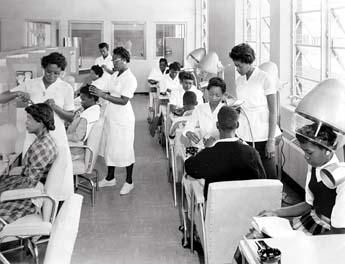
Bronner Brothers was founded in Atlanta in 1947 by Nathaniel H. Bronner Sr. and his brother Arthur E. Bronner Sr. The company predates the Civil Rights Act by nearly two decades. It was built during a period when Black entrepreneurs had no access to mainstream retail or distribution infrastructure -- they built their own. Bronner Brothers developed hair care product lines including BB African Royale and Tropical Roots, and by the 1950s had become a foundational institution in Black professional beauty. The company created what is now the Bronner Brothers International Beauty Show, the largest African American hair show in the country, which has run continuously for more than 75 years. The Bronner Brothers International Beauty Show is not a trade event that happens to attract Black attendees. It is the event. It has trained generations of Black cosmetologists, launched careers, and served as the single largest gathering point for the Black beauty professional community every February in Atlanta. The company remains privately held by the Bronner family.
Luster Products followed in 1957. Fred Luster Sr. was a Chicago barber who began formulating products for his clientele because what existed on shelves did not serve the hair he was working with every day. He sold them out of his barbershop first. Demand grew. He incorporated Luster Products Inc. that year and built it into one of the longest-running Black-owned hair care companies in the world. The flagship Pink brand -- the pink lotion, the hot oil treatment -- became a household staple across generations of Black families. Luster Products also built SCurl and PCJ into major product lines. Today the company manufactures more than 125 products distributed in over 70 countries. It is still family-owned, still Black-owned, still Chicago-based. When the natural hair movement accelerated in the 2010s and larger companies rushed to acquire or imitate what Black founders had been doing for decades, Luster had already been doing it for fifty years.
“Bronner Brothers opened in 1947. The mainstream beauty industry spent the next four decades pretending Black consumers did not exist. The company outlasted the pretending.”
Fashion Fair Cosmetics was founded in 1973 by Eunice W. Johnson -- wife of John H. Johnson, the publisher of Ebony and Jet magazines. The origin is specific and worth holding: the Ebony Fashion Fair was a traveling runway show that Johnson had organized since 1958, and the models she dressed could not find foundation that matched their skin. The makeup industry had not built for them. Johnson built it herself. Fashion Fair became the first cosmetics line developed specifically for darker skin tones to achieve wide national distribution, carried in more than 1,500 department stores by the late 1980s. At its peak it was a $60 million business. The brand entered decline in the 2010s as the market fragmented and competitors with larger budgets moved into the space Fashion Fair had pioneered. It filed for bankruptcy in 2018. In 2021, New Orleans native Desiree Rogers and businesswoman Cheryl Mayberry McKissack relaunched the brand, returning it to retail with updated formulations and the same founding mission. Fashion Fair is now operating again -- a second chapter for a brand that built the template.
Black Opal sits in a different category and deserves a clear accounting of what it is and what it was. The brand was founded in 1994 by Niko Mouyiaris, a non-Black entrepreneur who developed the line with board-certified dermatologist Dr. Cheryl Burgess specifically for women of color. It was not Black-owned at founding. What Mouyiaris and Burgess built was rigorous -- products formulated around melanin-rich skin, developed in partnership with a Black dermatologist, and positioned at a moment when the ethnic beauty aisle was still largely controlled by distributors with no real investment in the consumers they were serving. The brand became a pillar of the drugstore aisle for Black women for 25 years. When Mouyiaris died in 2019, Desiree Rogers and Cheryl Mayberry McKissack acquired it, making Black Opal Black-owned for the first time in its history. The brand has since rebranded as BLK/OPL while maintaining its formulation philosophy. Its history is not one of unbroken Black ownership -- but its 30-year presence in the market, and the hands it is in now, put it in a category of legacy brands worth understanding on their own terms.
What these four companies share is longevity in a market designed to make Black business longevity difficult. They were built without access to mainstream distribution, without venture funding, without the consumer-facing amplification that social media now provides. They built through word of mouth, through professional networks, through the trust of Black consumers who had learned that the alternative was a market that did not see them. The companies that tried to serve Black consumers without that trust are mostly gone. These are still here.